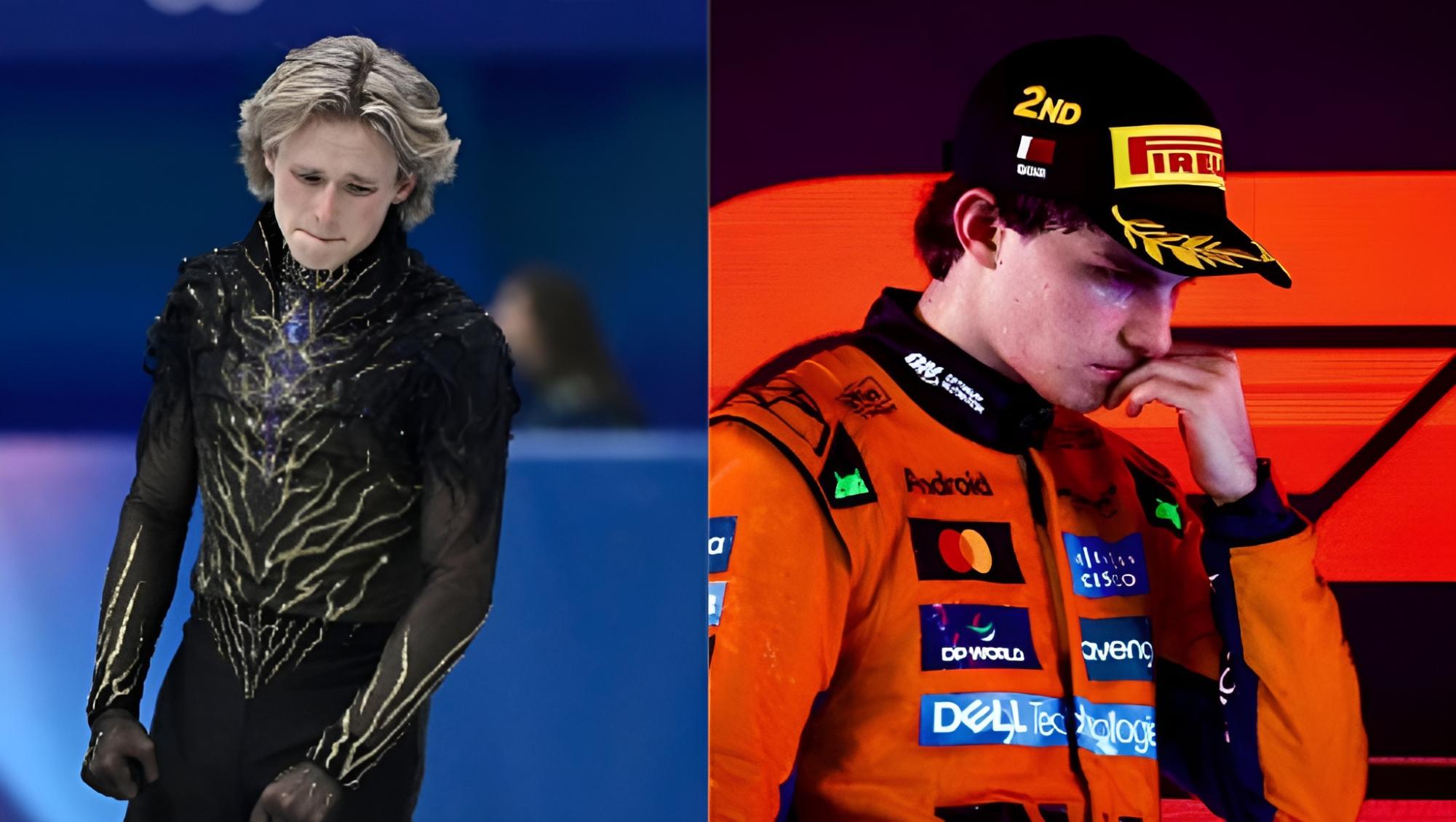
The blade carves a clean edge into Olympic ice, the sound sharp enough to cut through an arena that has already decided what it expects to see. Across the world, under the glare of Formula 1 floodlights, a car engine roars through the crowd as it hurtles towards the first braking zone of the race.
Different continents, different sports. But there is that same silence before performance, the one that comes with the understanding that it is no longer about potential, but rather about becoming proof of fulfilling pressure-induced expectations. On the ice stands Ilia Malinin, the American figure skater who landed the sport’s most technically-difficult jump, the Quadruple Axel, and inherited the label of “Quad God” before he had even hit Olympic ice. On the grid sits Oscar Piastri, a driver whose expanding championship led in the first half of the 2025 season made clinching the title feel inevitable.
Both of them were expected to win—to dominate their respective championships. However, what followed in these expectations’ wake said as much about the culture surrounding elite sport as it did about their performances.
In Malinin’s case at the 2026 Winter Olympics in Milan-Cortina, his debut performance at the individual men’s competition fell short of expectations that he would seek victory. He is a skater whose combination of athleticism and technical skill has redefined the sport. Yet, in his free skate, uncharacteristic errors, including two falls, pushed him from first place to well out of medal contention in eighth place.
Similarly, Piastri’s 2025 season became increasingly underwhelming as strategy missteps, personal mistakes, and the increasing pace of his rivals brought a title challenge into question. So, if they were the clear favourites, what happened to them?
Speculators pointed to bad luck. Others questioned consistency. But under closer inspection, a pattern emerged that became hard to ignore: Both seasons unfolded under the weight of expectation that topped skill.
When Malinin landed the first-ever Quad Axel, he not only expanded figure skating’s technical ceiling, but he also inherited the burden of carrying it. Every program of his that followed this feat was measured not against his other competitors, but against the “Quad God” that people had made him out to be. However, this label became his downfall. In an interview with The Today Show, Malinin admitted the immense toll the pressure took on him. “The most honest way to say it is it’s just a lot of on you, just so many eyes, so much attention,” he said. “It really can get to you if you’re not ready to fully embrace it. So, I think that might be one of the mistakes I made going into that free skate… I was not ready to handle that to a full extent.”
West High flag football and soccer athlete Addison Parker (10) described a similar strain at the high school level. When she makes mistakes, she notes that “peers are quick to judge,” and the attention that comes with success “affects [her] mentally and emotionally, which ultimately negatively affects [her] performance.”
Rising attention that came with Piatri’s success was also seen throughout the Formula 1 season. A championship lead early in the season reframed him from emerging contender to presumed title-holder. Nobody expected a driver with three years of Formula 1 experience to be fighting for a title, and the world loved it—in fact, they soon began to expect it. However, on the podcast Beyond the Grid, Piastri spoke candidly about the pressure: While he appreciated it as a sign that he was in contention for the championship, he admitted that it could also be “tough… [it was] uncomfortable at times.” Sometimes, discomfort is enough. Each mistake became amplified until he suddenly slipped behind.
Although Piastri sought the attention as an indicator that he was performing well in his season, the current culture of elite sport leaves little room for development. Athletes are branded prodigies immediately, and mistakes are no longer a part of learning. Rather, they are interpreted as failing. Modern sports struggle to tolerate development, instead focusing on immediate success. Both Malinin and Piastri faced this tough environment. Their skills and talent remained unquestioned, but demand for immediate success created a weight that even the most gifted of athletes struggle to carry.
On ice and asphalt, both Malinin and Piastri were not measured against their peers, but against the immaculate athletic versions of themselves shaped by pressure. And perfection leaves little room to breathe.