
Editor’s Note: This article contains spoilers from season three of “Bridgerton.” This article is a piece of fan commentary and reflects the writer’s interpretation of the show.
When it comes to adapting a book series into a television show, certain changes need to be made to fit the new medium. As such, producers of the show will often take creative liberties with the story and cast. This would be the case for book series adaptation “Bridgerton,” a drama series created by television production company Shondaland. For a long time, the creative liberties worked in the show’s favor, but some have started to take a downfall
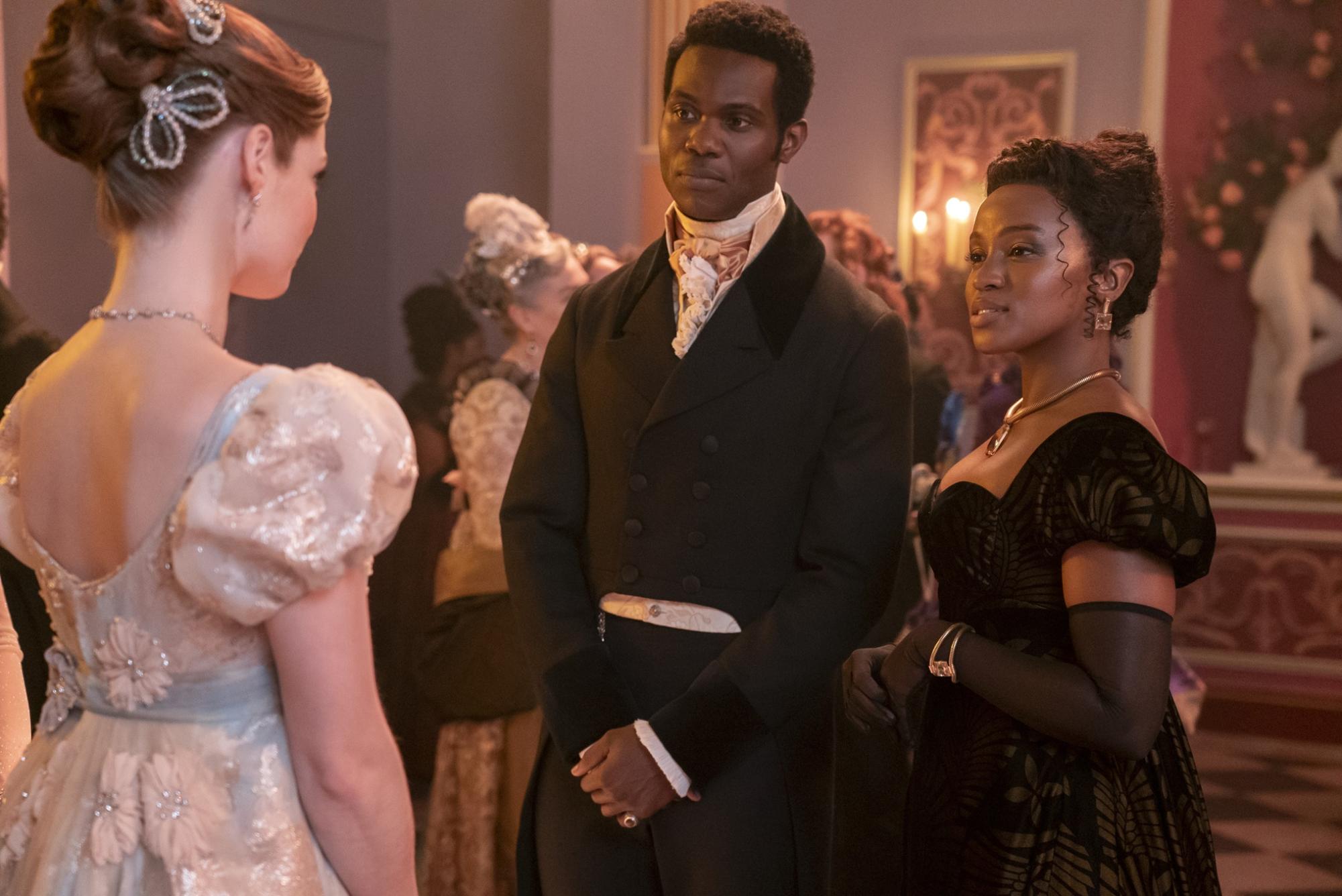
“Bridgerton” is often categorized as a “bodice ripper,” describing a steamy historical romance with historical elements that are not necessarily accurate. Although this lack of historical accuracy has resulted in people nitpicking the costumes or makeup online, very few have complaints about the racial and ethnic diversity among the large ensemble cast.
While the books consist of only white characters, the show has had people of color portray those roles on screen. This diversity garnered much praise for the show, as it allowed people of color to be portrayed as desirable love interests and gave viewers the opportunity to see people of their race represented in a historical romance (without dealing with racism or bigotry so commonly associated with the times). For many fans of the show, simply enjoying the swoon-worthy, regency-era romance without the complications of the historically accurate racial tensions has been especially meaningful. However, the producers’ creative liberties may have gone too far, as the show’s queer representation has been met with mixed reactions from the viewers.
These reactions first showed up in season three, which was not very well-received for a multitude of reasons, with two reasons particularly standing out: Benedict’s experimentation with his sexuality and his realization that he enjoys the company of men and women; Francesca’s love interest from the novel, Michael Sterling, becoming Michaela Sterling.
Starting with Benedict, most complaints say that the character’s side plot seemed like filler material, adding no purposeful folds to the show. Suffice to say, the majority of fans were confused, even though some had already interpreted Benedict as queer prior to its confirmation in season three.
The issue most people have with Benedict’s plot was the character’s story arc. Showrunner Jess Brownell claimed that him and his colleagues “had been talking about it in the writer’s room honestly from season one” in an interview with Teen Vogue. Brownell noted that Benedict “is not as focused on gender so much as he is on connection.” And many fans (including myself) agree with this sentiment! However, this did not align with the way Benedict’s arc was written which felt like a throwaway plot, with no real purpose. If the writers had made his relationships more focused on the connection of “spirit, energy and [the] connection of minds and interests,” as Brownell described it, rather than just physical connection, maybe it would have been better received.
In the case of Francesca, many fans were much more vocal about their disapproval of Michael becoming Michaela in the show’s adaptation. This is partially because the main conflict Francesca and Michael faced in the books was related to struggles with infertility. However, most criticism stems from Francesca’s early attraction to Michaela because it overlooked her love for her husband and Michaela’s cousin, John Kilmartin.
As a lesbian fan of the series, I would have loved to see this story be explored in depth and to see myself represented in one of my favorite shows. However, I had already seen myself in Francesca and John’s relationship earlier in the season. Francesca is a character that exhibits many neurodivergent traits, leading her to find a more peaceful and quiet love with John rather than the dramatic and all-consuming love her mother wished for her. I loved John and Francesca’s relationship because it showed that love could look different and could be expressed in different ways for different people. Having Francesca stumbling over her words when meeting Michaela undermines Francesca’s love for John, making it seem invalid in comparison to her attraction to Michaela.
What showmakers could have done was have Michaela fall head over heels for Francesca upon meeting her — in the same way Michael is described to act in the books. Showmakers didn’t have to change much about their first meeting akin to how they didn’t have to change much when casting people of color.
Some fans that were against this change in queer representation mentioned that if shoemakers wanted to have a sapphic love story in “Bridgerton”, they should have involved Eloise who is known as the more opinionated and radical Bridgerton sister. However, arguing that Eloise being queer “makes more sense” than Francesca being queer relies on stereotypes and can come across as homophobic. Such claims contribute to the societal norm that there is a certain type of woman who acts queer. As much as I would love to see more sapphic representation in “Bridgerton”, I don’t find myself a fan of making Eloise queer in the show because it just feeds into stereotypes about what queer women “should” look and act like.
The change of making Michael a woman in the show isn’t the problem; rather, it’s altering the story to fit a stereotypical sapphic romance, which many fans take issue with. , Despite public criticism from fans, the showrunners have seemed to fully commit to the change in the new season. Many fans are distraught, even threatening to not watch Francesca’s season whenever it may come out. I, however, as well as many others can just hope it will make for good television.