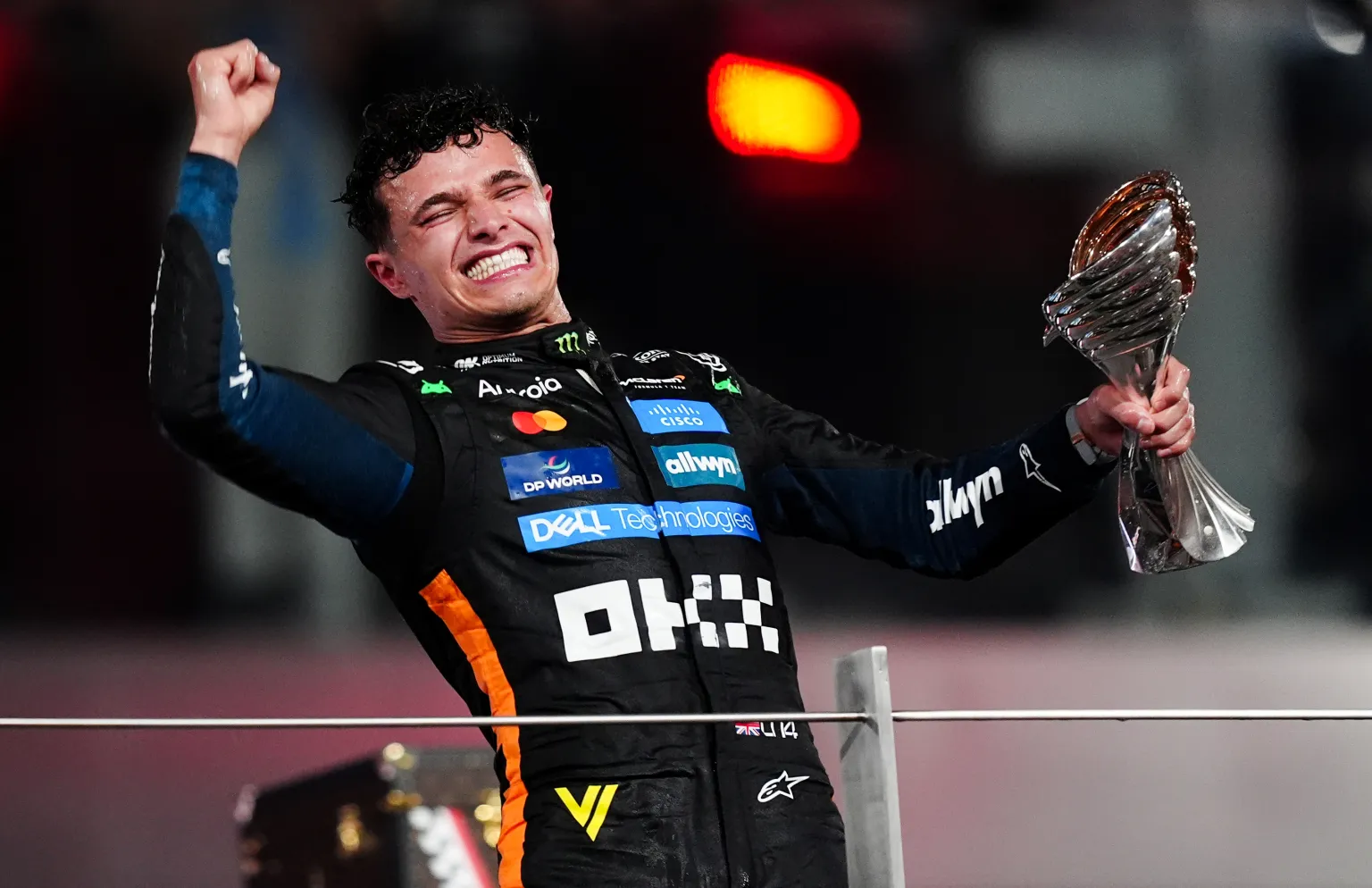
As darkness fell across the Yas Marina Circuit in Abu Dhabi, the grandstands found a single rhythm: Lando. Lando. Lando. Lando Norris, British racer for the McLaren Formula 1 Team, stood on the podium, helmet off, eyes wide, as if he had not quite registered what the world already knew—he was the 2025 Formula 1 World Driver Champion. It was the final act of an electric three-way championship fight—Lando Norris versus Max Verstappen versus Oscar Piastri. With 423 points, Norris was crowned World Champion, finishing two points ahead of Oracle Redbull Racing’s Max Verstappen. But while the numbers tell the season’s story, they do not explain what it takes to win the Formula 1 World Championship. The sport has long celebrated a certain type of champion—cold, untouchable, and supremely confident. Norris’s journey challenges this myth.
At its core, what fans call the Formula 1 “championship mentality” does not only relate to speed or skill—it rewards emotional untouchability, with any sign of doubt or vulnerability seen as a weakness. But how did this overbearing standard start, and did it exist from the very beginning?
Early Formula 1 competitions were brutally dangerous. From the sport’s founding in 1950 to the 1990s, car unreliability and limited safety measures contributed to approximately forty-seven drivers’ deaths, including three-time World Champion Ayrton Senna. In such an environment, emotional distance was not optional—it was survival, for many racers were putting their lives on the line. With drivers strapping into cars capable of fatal error at every corner, even a moment of hesitation or self-doubt could cause them to crash. In racing, uncertainty about when to break, or how to overtake means the difference between victory and a disaster. When the cost of hesitation could be fatal, detachment becomes a professional necessity. Even after the sport became marginally safer with the introduction of new safety features, this brutal mindset stood.
In fact, as Formula 1 approached the early 2000s, the Michael Schumacher era reinforced the “championship mentality.” Because Schumacher was so dominant, being a 7-time World Champion with 91 career wins, fans started to use him as a blueprint for future champions. Schumacher’s calm, focused presence on the radio earned him the engineers’ trust. His emotional restraint in tense races gave him a psychological edge over rivals. His unique temperament conveyed authority, shaping how the media, his team, and his rivals treated him. The way he managed emotion became the standard, not the exception. This style of composure and authority set the stage for the next several champions, including four-time World Champion Max Verstappen.
The idea of “championship mentality” is inseparable from the gendered expectations that shaped the sport itself. Formula 1 has long been male-dominated, and with that dominance came a familiar script: Emotion is weakness, and pressure is something real champions endure without complaints.
In Formula 1’s modern era, Max Verstappen is often seen as the ultimate embodiment of this “championship mentality.” Relentlessly confident, unafraid to push limits on track, and almost never showing doubt publicly, Verstappen showcases the kind of aggressive certainty that the sport has long celebrated. His disregard for what others think has been hailed as legendary; in an interview, Verstappen stated, “I’m not here to be loved…I’m here to do my job.” Every move of his is decisive; every calculated risk comes with this statement: The championship belongs to him.
In contrast to Verstappen’s aggressively confident attitude, a significant part of Norris’s revolved around self-doubt. His mentality was not only read as a lack of confidence—it violated an unspoken rule about how elite male athletes are supposed to behave. In the Netflix docuseries Drive to Survive, F1 commentator Will Buxton, highlighted this stark contrast between Verstappen and Norris: “‘The critical difference between Max and Lando…Max has a complete f***-you mentality.” Against this backdrop, Norris’s openness about self-doubt and his emotional transparency stand in sharp contrast, challenging the notion that emotional detachment is required to win at the highest level.
Indeed, Norris is known as one of the most emotionally-open drivers in Formula 1, frequently discussing his feelings and mental health journey. Fans often describe Norris’s unique mentality as honest and vulnerable, a direct contrast to the acclaimed “championship mentality.” In late 2020, Norris revealed how during his rookie season, he struggled with “nerves and anxiety,” and was “depressed a lot.” He also confessed to frequently comparing himself to other drivers, a habit that took a toll on his mental state. Norris has also openly acknowledged struggling with self-doubt, telling BBC Sport, “I have not always had the most belief in myself.” But beyond his own experiences, Norris actively advocates for mental health awareness in Formula 1, encouraging drivers and fans alike to speak openly about their struggles. He has said that he is “very happy to see more and more people speaking out about [mental health],” highlighting his commitment to changing the culture around openness to the sport. However, not all fans are as enthused as Norris about his emotional vulnerability.
Fans and commentators questioned whether Norris’s emotional transparency was compatible with a championship mindset. Many called him weak, fragile, and inferior to Verstappen’s relentless, no-doubt approach. One Reddit user commented, anonymously, that Norris “hides behind a shield of his ‘mental health’ when things aren’t going well for him,” adding that he will often “quickly retreat from a fight.” Twitter user F1Dreamerz echoed this sentiment, asserting that Norris “has not got the championship mentality.”
Social media users are not the only ones who criticize Norris for his mentality. Helmut Marko, who previously served as motorsport advisor to Red Bull GmbH, also made similar claims, mocking Norris in German press before the US Grand Prix as “not the strongest mentally” during the Verstappen–Norris title fight. Others shared this view, arguing whether Norris’s self-confidence was strong enough to contend for championships.
However, many Formula 1 viewers saw his openness refreshing in a sport long dominated by emotional stoicism: “I really appreciate how open [Norris] is about [mental health],” says Reddit user u/Hicks12. Norris fan Aubrey Hunter (10) shares a similar sentiment, explaining that “Lando does have the championship mindset…he did good…in his races…I’m very happy for him for winning the driver’s championship.” In the end, that is what it came down to—Lando Norris winning his title.
Through his championship win, Norris has completely re-written what the “championship mentality” means. He has shown the world of Formula 1 that there is no set mentality that one needs to be a champion. In an interview, Norris mentioned that he was very proud to win the championship on his own terms and not by being the “most aggressive” or the “most ‘screw everyone else’” like what was previously expected of champions. However, Norris also praised Verstappen’s characteristics, even though many believed that they aligned with “championship mentality.” He admitted, “sometimes …‘I wish I was more like that’…What I’ll be most proud of is if I can do it, and just do it my way. I can set—not a new standard, but a new way of ‘you don’t need to have that kind of attitude.’” Norris deviating from past standards left people scrambling to figure out what it truly means to be a champion—Norris’s teammate, Australian Formula 1 driver Oscar Piastri, agreed with Norris, explaining that the “championship mentality” does not mean “you need to be a bad person…The most important thing is to try and do it the way you want to do it.”
Formula 1 has long told a single story about what it takes to be a champion: Emotional distance, ruthless confidence, and an unbreakable exterior. Norris did not fit that mold. He doubted himself publicly, spoke openly about his struggles with mental health, and refused to be invulnerable for the sake of following the golden champion standards. Norris’s victory does not erase the sport’s past, nor does it invalidate his predecessors’ mindsets. Instead, it expands the definition of what is possible. In a sport built on speed, risk, and pressure, Norris proved that strength can look like honesty—and that vulnerability, when paired with resilience, can still stand atop the podium.